Food safety remains one of the strongest trust signals in the food system. FSANZ’s latest recall data shows 92 food recalls in 2025, above the 10-year average of 87. Undeclared allergens were the leading cause, accounting for 38% of recalls, with packaging errors, cross-contamination, and ingredient-change communication identified as recurring contributors (Food Standards Australia New Zealand [FSANZ], 2026a).
That does not mean confidence is collapsing. FSANZ’s Consumer Insights Tracker reports around 70% consumer confidence in food safety and around 80% confidence in using labels (FSANZ, 2026b). The message for industry is more practical: trust is not built by slogans. It is built by systems that make safety visible, repeatable, and verifiable.
For processors, the recall picture highlights several priorities. Allergen control still depends on disciplined supplier communication, accurate packaging, and change management. Microbial safety depends on validated interventions that fit the pathogen, product, matrix, and processing step. Traceability helps businesses respond faster when something goes wrong, but prevention remains the higher-value goal.
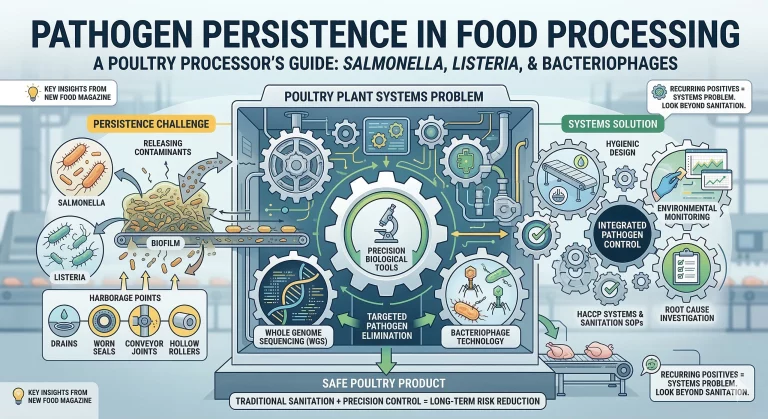
This is where precision biology is becoming more relevant. Bacteriophages are naturally occurring viruses that target specific bacteria. In Australia and New Zealand, bacteriophage technology has already entered regulated food applications. FSANZ has approved bacteriophage processing aids for specific food safety uses, demonstrating that targeted biological interventions can be incorporated into existing food safety systems when supported by appropriate safety and efficacy evidence. Recent research continues to show promise for phage cocktails in reducing Salmonella and some E. coli loads on raw chicken under chilled storage, while also reinforcing that results depend on strain fit, dose, food matrix, and validation conditions (Frontiers, 2026).
The most useful way to talk about phage is not as a silver bullet. It is as a targeted tool that can sit inside existing HACCP, GMP, hygiene, QA, and traceability programs. That distinction matters. “Natural” is not enough on its own. Food businesses need evidence, regulatory clarity, manufacturing reliability, and measurable outcomes.
For Astrabio, the July 2026 industry signal is clear: food safety is moving toward more precise, data-informed, prevention-focused control. Inference: as throughput increases and supply chains become more scrutinised, the value of validated microbial interventions will only grow.
References
- Food Standards Australia New Zealand. (2026a). Recall statistics. foodstandards.gov.au
- Food Standards Australia New Zealand. (2026b). Consumer Insights Tracker. foodstandards.gov.au
- Food Standards Australia New Zealand. (2012). Approval report: Listeria phage P100 processing aid. foodstandards.gov.au
- Food Standards Australia New Zealand. Application A1045 – Bacteriophage Preparation as a Processing Aid. https://www.foodstandards.gov.au/
- Frontiers. (2026). Study on phage cocktails and pathogen reduction on raw chicken under chilled storage. frontiersin.org