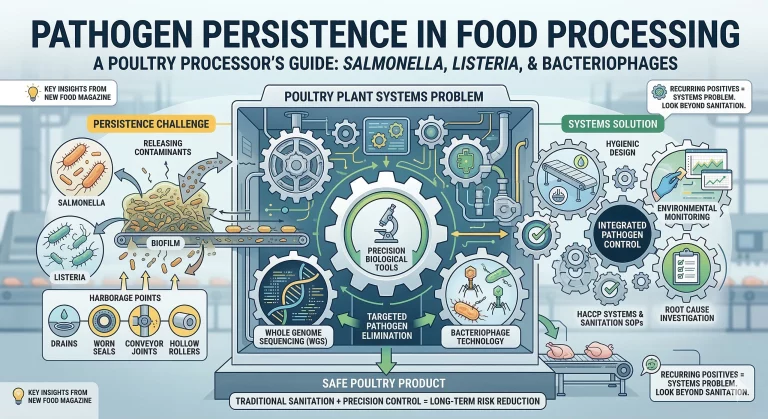
Food manufacturers are under growing pressure to reduce contamination risk while maintaining product quality, shelf life, and operational efficiency. Traditional sanitation methods remain essential, but processors are increasingly exploring precision biology tools such as bacteriophages to strengthen food safety systems.
Bacteriophages, or phages, are naturally occurring viruses that target specific bacteria. Unlike broad-spectrum chemical treatments, phages can selectively reduce pathogens such as Listeria monocytogenes, Salmonella, and pathogenic E. coli without disrupting beneficial microbes or affecting product quality. Recent reviews highlight their growing role in modern food processing because of their specificity and compatibility with existing hygiene programs.
The commercial momentum is accelerating. In 2025, the U.S. FDA reviewed GRN 1215, a Listeria-targeting phage preparation intended for use on meat, produce, fish, and dairy products. The filing reported lytic activity against nearly 90% of tested Listeria monocytogenes strains and confirmed compatibility with standard food manufacturing practices.
This matters because Listeria remains one of the most serious foodborne pathogens. The USDA estimates around 1,600 listeriosis cases and approximately 260 deaths annually in the United States alone.
In practical processing environments, phages are not designed to replace sanitation or environmental monitoring. Their value comes from fitting into a multi-hurdle food safety strategy. Applications may include intervention at post-lethality processing points, surface treatment in ready-to-eat production, or targeted control in high-risk zones where biofilms are difficult to manage. Emerging research also shows promise for phage-based approaches against antimicrobial-resistant bacteria and persistent biofilms on equipment surfaces.
As regulators continue emphasizing prevention-based food safety systems, precision biological interventions are becoming more commercially relevant. The future of food safety will likely combine traditional controls with highly targeted biological tools that improve both safety outcomes and operational resilience.
Reference
Food Safety and Inspection Service. (n.d.). Listeria monocytogenes. U.S. Department of Agriculture. https://www.fsis.usda.gov/inspection/compliance-guidance/microbial-risk/listeria-monocytogenes
U.S. Food and Drug Administration. (2025). GRAS notice no. GRN 001215: Listeria phage preparation. https://www.fda.gov/media/188224/download
U.S. Food and Drug Administration. (2025). GRAS notice (GRN) 1215 with amendments: Applied phage LI antimicrobial to control Listeria monocytogenes. Regulations.gov. https://downloads.regulations.gov/FDA-2025-N-1927-0058/attachment_1.pdf
U.S. Food and Drug Administration. (2026). Human Foods Program 2026 priority deliverables. https://www.fda.gov/about-fda/human-foods-program/human-foods-program-2026-priority-deliverables
ScienceDirect. (2025). Regulatory landscape and the potential of bacteriophage applications in food safety. https://www.sciencedirect.com/science/article/pii/S0362028X25000626
American Society for Microbiology. (2026). New antibiotic alternative fights foodborne Salmonella. https://asm.org/press-releases/2026/march/new-antibiotic-alternative-fights-foodborne-salmon
Intralytix, Inc. (2026). Bacteriophage-based biocontrol as an emerging green technology for improving food safety. https://www.intralytix.com/