
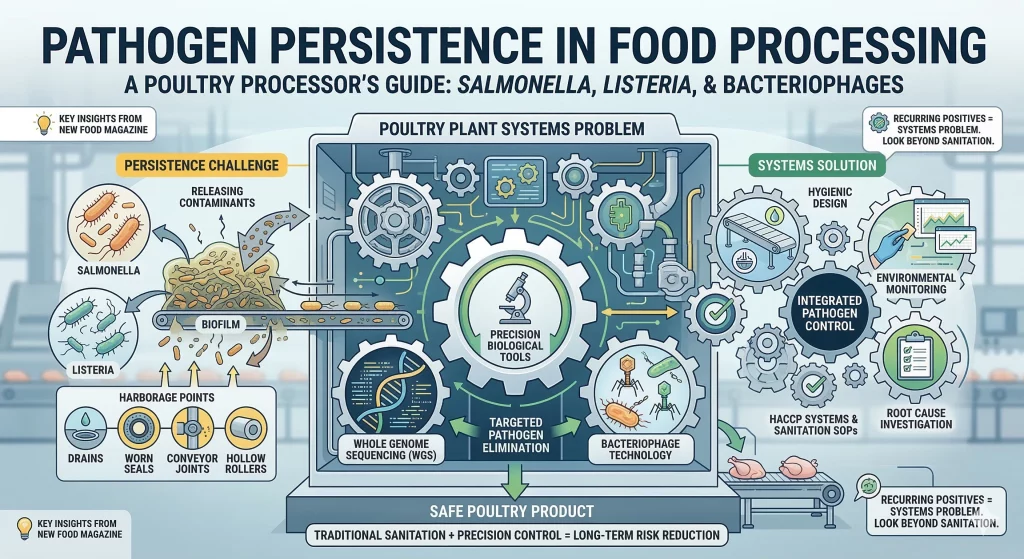
For poultry processors, food safety managers, QA leaders, and compliance teams, recurring environmental positives are rarely just a cleaning problem. They are often a signal that pathogens have found ways to survive inside the plant through biofilms, hidden harborage points, moisture, equipment design issues, or repeated traffic patterns. That is the central takeaway from the New Food Magazine article: pathogen persistence is a systems problem, not simply evidence that a sanitation crew missed a step.
The article Unpacking the evolving science of pathogen persistence in food processing environments argues that modern plants may have better chemistry, faster diagnostics, and more mature preventive controls than ever before, yet organisms such as Listeria monocytogenes and Salmonella can still reappear without an obvious breakdown in protocol. It highlights a growing industry shift from asking whether sanitation matters to asking what recurring positives reveal about infrastructure, hygienic zoning, cleanability, and the limits of traditional control strategies.
That framing aligns with EFSA’s scientific opinion on persistence, which identifies Listeria monocytogenes and Salmonella enterica as key public-health hazards associated with persistence in food and feed processing environments and points to inadequate hygiene barriers, equipment design shortcomings, and sanitation gaps as recurring contributors.
Why pathogens persist in food processing environments
Biofilms and harborage sites
One reason pathogens persist is biofilm formation. In biofilms, microorganisms attach to surfaces and embed themselves in protective matrices that make them harder to remove and more tolerant to sanitizers and environmental stress. The New Food article also emphasizes the role of harborage sites such as drains, worn seals, hollow rollers, conveyor joints, and framework interiors, where moisture and residue can support survival and reseeding.
A 2025 systematic review and meta-analysis reinforces that point: chemical sanitizers reduced pathogen biofilms by an estimated mean of about 2.90 log, but performance varied by sanitizer type and conditions. In practice, that means sanitation can reduce risk substantially without always eradicating established biofilms or protected niches.
Why recurrence is a systems issue
Persistent contamination often reflects plant geography as much as microbiology. Weak zoning, poor drainage, difficult-to-clean equipment, wet-dry crossover, condensation, and inaccessible surfaces can create microenvironments where pathogens survive routine interventions. For poultry operations, that matters because recurrence can be driven by design and workflow issues that standard “clean harder” responses do not fix.
Implications for poultry processing and food safety systems
In raw poultry, persistence raises contamination pressure and makes process control harder. FSIS says poultry establishments should combine pre-harvest and post-harvest interventions for Salmonella as part of their HACCP system and use microbial testing to monitor performance. For QA and compliance teams, that means recurring findings should be trended as signals of system weakness, not treated as isolated events.
In ready-to-eat poultry, the stakes are even higher. U.S. regulations state that L. monocytogenes can contaminate post-lethality exposed RTE products and must be controlled through HACCP or prevented in the processing environment through sanitation SOPs or other prerequisite programs, with food-contact surface testing required in certain control alternatives.
The limitations of traditional sanitation methods
Sanitation remains foundational, but persistence science shows its limits when used alone. The New Food article notes that recurrence is not always resolved by intensifying sanitation, and the sanitizer meta-analysis shows why: efficacy depends on pathogen, surface, sanitizer chemistry, and biofilm state. For poultry plants, the better model is validated sanitation plus hygienic design, targeted disassembly, drying, environmental monitoring, and root-cause investigation.
Emerging biological and precision approaches
Where bacteriophage technologies fit
The next generation of pathogen control is more precise. Whole genome sequencing is already being used by FDA to compare pathogens from food and environmental samples with clinical isolates, support outbreak investigations, and help determine whether strains are persisting in the environment over time. That makes sequencing valuable not only for traceback but also for understanding whether a facility is dealing with one entrenched strain or repeated reintroduction.
Biological tools also belong in that discussion. A Frontiers review notes that bacteriophages can be used in poultry settings to reduce bacterial contamination not only in animals but also on food-contact surfaces and poultry carcasses. Their value is specificity: they target bacteria rather than broadly disrupting the environment. But phages are not a replacement for sanitation. Their performance depends on host range, stability, resistance management, and formulation, so they work best as part of a layered food safety strategy.
Future trends in pathogen control and monitoring
The direction of travel is clear: more data-rich surveillance, more targeted intervention, and stronger integration between environmental monitoring, sanitation validation, hygienic design, and biological control. The New Food article points to experimental anti-biofilm strategies beyond conventional chemistries, while FDA’s WGS program shows how genomic tools are expanding proactive monitoring. Facilities that treat persistence patterns as actionable intelligence will be better positioned to reduce long-term risk.
Pathogen persistence is not just a sanitation failure. It is a plant-wide systems challenge that requires better visibility into where pathogens survive, why they return, and which interventions actually change that pattern. In poultry processing, the strongest programs will combine sanitation, hygienic design, environmental monitoring, genomic insight, and precision biological tools such as bacteriophage pathogen control.
Reference
- Nestlé Quality Assurance Center. (2026, February 23). Unpacking the evolving science of pathogen persistence in food processing environments. New Food Magazine.
https://www.newfoodmagazine.com/article/265620/unpacking-the-evolving-science-of-pathogen-persistence-in-food-processing-environments/ - EFSA Panel on Biological Hazards (BIOHAZ). (2024). Persistence of microbiological hazards in food and feed production and processing environments. EFSA Journal, 22(1), e8521.
https://doi.org/10.2903/j.efsa.2024.8521 - Hamilton, A. N., Jones, S. L., Baker, C. A., Liang, X., Siepielski, A., Robinson, A., Dhulappanavar, G. R., & Gibson, K. E. (2025). A systematic review and meta-analysis of chemical sanitizer efficacy against biofilms of Listeria monocytogenes, Salmonella enterica, and STEC on food processing surfaces. Journal of Food Protection, 88(5), 100495.
https://doi.org/10.1016/j.jfp.2025.100495 - U.S. Department of Agriculture, Food Safety and Inspection Service. (2021, July). FSIS guideline for controlling Salmonella in raw poultry (FSIS-GD-2021-0005).
https://www.fsis.usda.gov/guidelines/2021-0005 - Electronic Code of Federal Regulations. (2026). 9 C.F.R. § 430.4 Control of Listeria monocytogenes in post-lethality exposed ready-to-eat products.
https://www.ecfr.gov/current/title-9/part-430/section-430.4 - U.S. Food and Drug Administration. (2024, August 30). Whole genome sequencing (WGS) program.
https://www.fda.gov/food/microbiology-research-food/whole-genome-sequencing-wgs-program - Abd-El Wahab, A., Basiouni, S., El-Seedi, H. R., Ahmed, M. F. E., Bielke, L. R., Hargis, B., Tellez-Isaias, G., Eisenreich, W., Lehnherr, H., Kittler, S., Shehata, A. A., & Visscher, C. (2023). An overview of the use of bacteriophages in the poultry industry: Successes, challenges, and possibilities for overcoming breakdowns. Frontiers in Microbiology, 14, 1136638.
https://doi.org/10.3389/fmicb.2023.1136638