
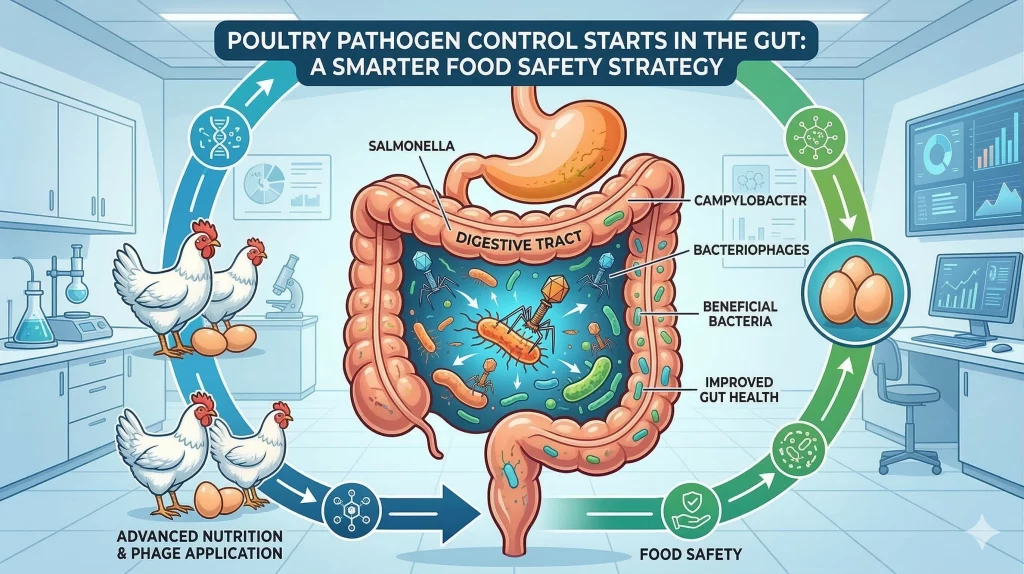
Poultry Pathogen Control Starts in the Gut
Poultry food safety is often discussed in terms of sanitation, processing controls, and regulatory compliance. Those remain essential. But the Poultry World article highlights a point the industry cannot afford to overlook: pathogen control starts before birds ever reach the plant. A healthier gut can help reduce the colonization and shedding of foodborne pathogens, which matters because Salmonella causes about 1.35 million infections annually in the United States, while Campylobacter causes an estimated 1.5 million illnesses and is commonly linked to raw or undercooked poultry.
The core message of the Poultry World piece is that the gastrointestinal tract is not just a digestive organ; it is a biological barrier where microbial balance, immune activity, and pathogen competition directly affect bird health and downstream food safety. The article emphasizes competitive exclusion, meaning beneficial gut microbes help occupy space and resources that pathogens would otherwise use. It also points to yeast-derived mannan-rich fractions as one example of a nutritional tool that may support microbial diversity and interfere with pathogen attachment in the gut.
Implications for poultry processing and food safety
FSIS guidance reflects the same multi-hurdle logic. The agency’s Campylobacter guideline says poultry establishments should use both pre-harvest and post-harvest interventions as part of HACCP and use microbial testing to monitor performance. In other words, the strongest poultry pathogen control programs do not begin at the chiller; they connect flock management, incoming-load risk, process control, environmental monitoring, and verification data into one food safety strategy. For Astrabio’s audience, that makes gut health not a nutrition side topic, but an upstream lever with downstream processing value.
Birds arriving with lower pathogen carriage do not eliminate risk, but they can improve the odds that in-plant interventions perform consistently. That is especially relevant for Salmonella control in poultry, where regulators continue to focus on science-based, measurable reduction strategies.
How precision biological approaches complement gut health strategies
Gut health and precision biological tools should be viewed as complementary, not competing, approaches. Peer-reviewed literature describes bacteriophages as highly specific viruses that target bacteria, with potential applications across the poultry chain, including live birds, food products, food-contact surfaces, and carcasses. Their specificity is attractive because it enables targeted action against pathogens without the broad microbial disruption associated with less selective approaches. At the same time, the literature is clear that phage performance depends on host range, formulation, stability, and resistance management. Used well, bacteriophage technologies can add a precise layer to broader programs built on gut integrity, biosecurity, sanitation, and verification.
Where bacteriophages fit best
The strongest fit is in integrated programs: gut-health strategies help reduce pathogen establishment upstream, while bacteriophages can provide targeted control where specific bacterial risks remain. That is a practical model for food safety teams looking to reduce Salmonella and Campylobacter risk without oversimplifying the biology of poultry production.
The regulatory direction also favors integrated, data-driven control. FSIS withdrew its 2024 proposed Salmonella Framework on April 25, 2025, and then held a January 14, 2026 public meeting to gather input on alternative, practical strategies, including better use of data and different performance-standard approaches. The signal for industry is clear: food safety expectations are still moving toward measurable pathogen reduction, even if the exact policy tools continue to evolve. Companies that combine flock-level prevention with targeted in-plant control will be better positioned for that future.
The Poultry World article is a useful reminder that poultry food safety is not won by processing interventions alone. A strong gut helps create a lower-risk bird, and a lower-risk bird supports a stronger processing outcome. For poultry processors, food safety managers, and industry professionals, the most resilient strategy is a layered one: gut health, biosecurity, sanitation, microbial verification, and precision biological tools such as bacteriophages working together.
Reference
- Walker, H. (2025, July 9). Building a stronger gut: The unsung hero in poultry pathogen control and food safety. Poultry World.
https://www.poultryworld.net/health-nutrition/nutrition/building-a-stronger-gut-the-unsung-hero-in-poultry-pathogen-control-and-food-safety/ - Food Safety and Inspection Service. (2021, July). FSIS guideline for controlling Campylobacter in raw poultry (FSIS-GD-2021-0006). U.S. Department of Agriculture.
https://www.fsis.usda.gov/guidelines/2021-0006 - Food Safety and Inspection Service. (n.d.). Reducing Salmonella in poultry. U.S. Department of Agriculture.
https://www.fsis.usda.gov/inspection/inspection-programs/inspection-poultry-products/reducing-salmonella-poultry - Abd-El Wahab, A., Basiouni, S., El-Seedi, H. R., Ahmed, M. F. E., Bielke, L. R., Hargis, B., Tellez-Isaias, G., Eisenreich, W., Lehnherr, H., Kittler, S., Shehata, A. A., & Visscher, C. (2023). An overview of the use of bacteriophages in the poultry industry: Successes, challenges, and possibilities for overcoming breakdowns. Frontiers in Microbiology, 14, Article 1136638.
https://doi.org/10.3389/fmicb.2023.1136638 - Food Safety and Inspection Service. (2025, December 15). Exploring practical strategies to reduce Salmonella in poultry products. Federal Register.
https://www.federalregister.gov/documents/2025/12/15/2025-22718/exploring-practical-strategies-to-reduce-salmonella-in-poultry-products